«De un modo u otro, los vamos a frenar»: la estrategia del Gobierno para detener Sea Lion pese al fallo del Tribunal del Mar (artículo traducido al inglés)
El organismo con sede en Hamburgo rechazó por 18 votos contra 3 las medidas provisionales pedidas por Buenos Aires, pero el Gobierno ya anticipó los próximos pasos del arbitraje y mantiene una ofensiva paralela de sanciones, denuncias penales y presión diplomática
El presidente Javier Milei junto a los ministros Luis Caputo (Economía) y Pablo Quirno (Relaciones Exteriores)
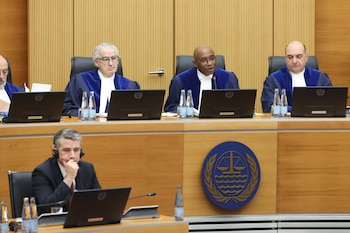
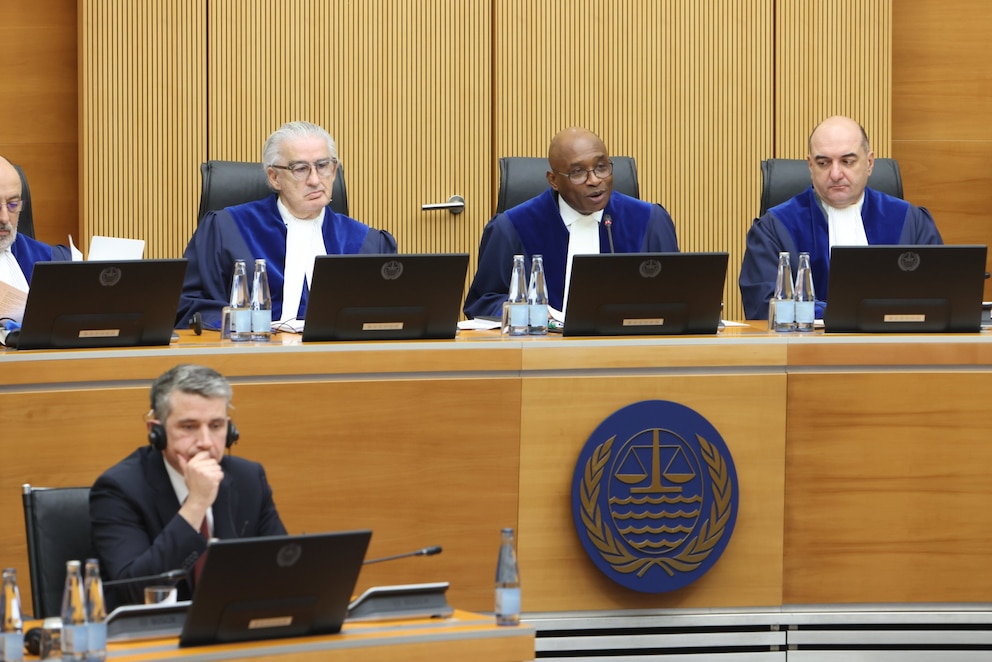
Buenos Aires, sábado 28 noviembre (PR/26) — “Nos dieron duro”. Esa fue la primera reacción de un importante abogado con llegada a las oficinas de Casa Rosada, ante la consulta de Infobae, cuando el presidente del Tribunal Internacional del Derecho del Mar (TIDM), el juez camerunés Maurice Kamga, terminó de leer en Hamburgo la orden que rechazó, por 18 votos contra tres, las medidas provisionales que Argentina había solicitado para frenar el proyecto Sea Lion en aguas próximas a las Malvinas.
Fue, para la Argentina, un revés en esta instancia del ámbito internacional para evitar que los ingresos de la explotación petrolera financien y consoliden la presencia británica en las Islas antes de que haya una resolución definitiva sobre la soberanía, una discusión que tiene lugar en otro ámbito: la ONU.
El fallo deja al consorcio Navitas/Rockhopper sin restricciones inmediatas para avanzar con perforaciones previstas para marzo de 2027. La proyección es millonaria: 23 pozos, una fase de producción de hasta 35 años y una extracción estimada de más de 310 millones de barriles. Y una ganancia de 70.000 millones de dólares, según estimaciones oficiales argentinas.
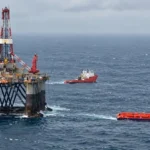
Una plataforma petrolera en mar abierto exhibe letreros de las empresas Navitas Petroleum y Rockhopper Exploration al atardecer. (Imagen Ilustrativa Infobae)
En este contexto, y mientras avanza el arbitraje de fondo, el Gobierno se rearma para intensificar una ofensiva jurídica y política en múltiples planos.
“Activar este mecanismo ante el Tribunal del Mar era uno más para intentar frenar de manera urgente las actividades”, señalaron desde la Cancillería a Infobae. Y agregaron: “Vamos a continuar con firmeza hacia el arbitraje y a utilizar todas las herramientas pacíficas que nos ofrece el derecho internacional, con toda nuestra capacidad diplomática, legal y económica. Lo estamos haciendo con firmeza y, de un modo u otro, los vamos a frenar”.
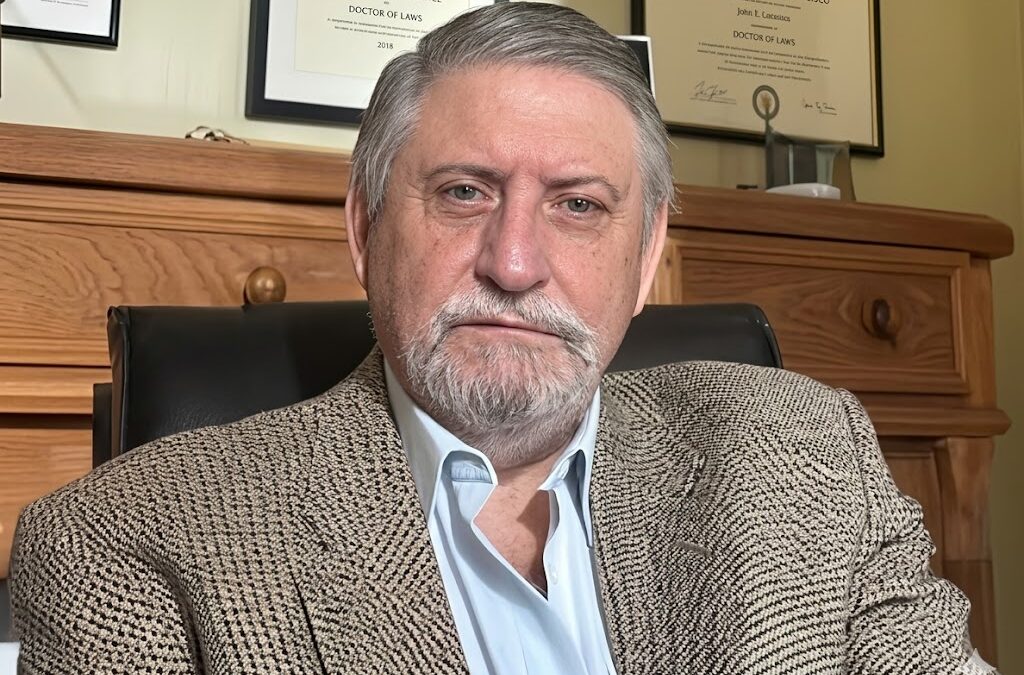
Así, Argentina avanzará en la constitución del Tribunal Arbitral del Anexo VII y solicitará ante él sus propias medidas provisionales. Leopoldo Godio, titular de Derecho Internacional Público de la Universidad Católica Argentina (UCA), anticipó a este medioque eso ocurrirá el año que viene. “Argentina va a tratar de pedir medidas distintas, algunas parecidas, y posiblemente tome nota de la disidencia del juez (Bimal) Patel, que es muy interesante”, sostuvo.
El presidente del TIDM, el juez camerunés Maurice Kamga (ITLOS)
La estrategia paralela al arbitraje, aseguran en Casa Rosada, incluye procedimientos sancionatorios contra 65 empresas, fondos de inversión, accionistas y proveedores vinculados a los proyectos en las Islas.
El viernes último, antes de conocerse la resolución del TIDM, el Gobierno sumó cinco nuevos expedientes contra accionistas de Navitas: Migdal Mutual, Harel Mutual Funds, Ayalon Mutual Funds, Tamir Fishman Mutual Funds y More Mutual Funds, entre otros fondos israelíes. También presentó denuncias penales contra operadores de aeronaves que ingresan al espacio aéreo argentino sin autorización.
PEsas medidas, según el Gobierno, ya tienen efectos concretos: las principales empresas de servicios petroleros del mundo —SLB, Halliburton, Baker Hughes, Tenaris y DLS Archer, entre otras— declararon públicamente que no participarán en proyectos en Malvinas.
El propio operador de Sea Lion reconoció que debió reemplazar a dos contratistas que abandonaron el proyecto y vinculó su salida con las presiones argentinas.
El presidente Javier Milei (REUTERS)
Otra variable es la política. El propio Javier Milei lo planteó en el comunicado oficial que difundió en X, donde cuestionó el fallo, sostuvo que “no es la última palabra” y reclamó a la Cámara de Diputados que trate y sancione la próxima semana la Ley de Defensa de la Soberanía Nacional. “Su demora entusiasma al gobierno británico”, sostuvo el mandatario.
“El que no acompaña tiene que explicarles a los argentinos por qué le parece bien regalarles a los ingleses 70.000 millones de dólares en petróleo”, señalaron desde el Gobierno. Cristian Ritondo, el jefe del bloque PRO en Diputados, se alineó: “Es momento de avanzar con su aprobación; la defensa de nuestros intereses estratégicos tiene que estar por encima de cualquier diferencia política”.
Para Godio, lo primero que hay que entender es el alcance real de la decisión del Tribunal del Mar. “Este caso que termina hoy no prejuzga sobre el fondo. Es una etapa estrictamente procesal, de medidas cautelares”, explicó. “No reconoce los derechos soberanos británicos, tampoco declara lícita la explotación de Sea Lion, tampoco niega la existencia de una controversia. Y tampoco resuelve la cuestión de Malvinas”, detalló.
El problema central, según el especialista, fue que el tribunal detectó una premisa implícita en casi todas las reclamaciones argentinas: para resolverlas, primero había que determinar quién es el soberano de las islas.
Y eso, bajo el mecanismo del Anexo VII de la Convención de las Naciones Unidas sobre el Derecho del Mar (Convemar), está fuera de la competencia del organismo en esta instancia.
Fue exactamente la estrategia del Reino Unido: encuadrar el debate como una disputa de soberanía territorial para sacar el caso del ámbito marítimo donde Argentina había apostado sus fichas.
El primer ministro del Reino Unido, Andy Burnham (REUTERS)
El TIDM sí registró en su resolución tres compromisos expresados por el Reino Unido durante las audiencias: que la extracción no comenzaría antes de marzo de 2028, que las perforaciones no se iniciarían antes del 21 de marzo de 2027, y que no se otorgarían nuevas licencias dado que el régimen de licencias se encuentra suspendido.
No los convirtió en medidas obligatorias, pero quedaron asentados formalmente ante el organismo.
El voto de 18 contra 3 fue abrumador, pero las disidencias le abren una ventana a Argentina. Godio destacó el argumento del juez Patel, en relación a la tercera reclamación argentina, vinculada a la protección del medio marino.
La mayoría del tribunal entendió que para determinar si existían obligaciones ambientales, primero había que saber quién ejercía soberanía en el área. Patel, en cambio, planteó que ciertas obligaciones de la Parte XII de la Convemar no dependen de la soberanía territorial del Estado, sino del tipo de actividades que se realizan en ese espacio.
Desde esa perspectiva, la pregunta relevante no sería de quién son las islas, sino si el Reino Unido realizó adecuadamente la evaluación de impacto ambiental, si intercambió información, si notificó riesgos, si preparó planes de contingencia. “Para mí es la verdadera crítica”, dijo Godio. “Yo creo que la estrategia argentina de fondo para el Anexo VII va a tener que tocar este punto”, analizó.
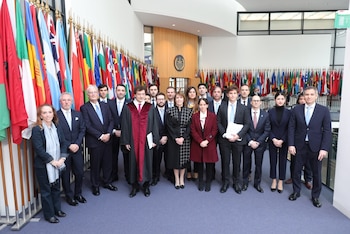
La delegación que representó a la Argentina en el Tribunal del Mar
Por otro lado, y consultado sobre si el fallo contrario en el TIDM debilita la posición argentina en el reclamo histórico sobre la soberanía de las Islas, Godio fue categórico: “No, para nada, porque justamente es el motivo por el cual está diciendo que no: no porque Argentina no tenga razón, sino porque el tipo de controversia mixta hace que el aspecto territorial desplace la característica marítima que es necesario que tenga el caso”, explicó.
Para el jurista, el tribunal adoptó una postura “un poco excesivamente cautelosa” al no reconocer la dimensión marítima del conflicto por la presencia del componente territorial. Pero eso no cierra el expediente: “Ahora la pelota la va a tener el tribunal arbitral”, sostuvo.
Y concluyó: “Era más fácil argumentar, dar medidas provisionales que argumentar que no. Y argumentaron que no. Eso es, francamente, un poco molesto”. Hasta hoy, el TIDM siempre había ordenado algún tipo de medida provisional. Esta es la primera vez que no decretó nada.
Por otro lado, Guillermo Carmona, ex secretario de Malvinas durante el gobierno de Alberto Fernández, manifestó sus críticas a la estrategia argentina encabezada por Pablo Quirno, el canciller que acumula cuestionamientos de la oposición, como el reclamo aireado de Miguel Angel Pichetto en el Congreso esta semana para interpelarlo por sus declaraciones sobre las elecciones en Brasil.
“Es una mala noticia no sólo por el contenido adverso del fallo, sino también por los impactos que tendrá en el proceso arbitral. Es más: Gran Bretaña lo intentará utilizar en la disputa de soberanía”, concluyó el ex diputado kirchnerista.
Primicias Rurales
Fuente: Infobae
Versión en inglés
“One Way or Another, We Will Stop Them”: The Government’s Strategy to Halt Sea Lion Despite the Tribunal of the Sea Ruling
Nov 28, 2026 | Current Affairs, Malvinas, Politics
The Hamburg-based body rejected the provisional measures requested by Buenos Aires by 18 votes to 3, but the Government has already previewed the next steps in arbitration and is maintaining a parallel offensive of sanctions, criminal complaints, and diplomatic pressure.
By Patricio Tesei
Photo caption: President Javier Milei alongside Ministers Luis Caputo (Economy) and Pablo Quirno (Foreign Affairs).
Buenos Aires, Saturday, November 28 (PR/26) — “They hit us hard.” That was the initial reaction of a prominent lawyer with access to Casa Rosada offices, when consulted by Infobae, after the President of the International Tribunal for the Law of the Sea (ITLOS), Cameroonian Judge Maurice Kamga, finished reading the order in Hamburg that rejected—by 18 votes to three—the provisional measures Argentina had requested to halt the Sea Lion project in waters near the Malvinas (Falkland Islands).
For Argentina, it was a setback in this international venue in its effort to prevent oil revenues from financing and consolidating the British presence in the Islands before a definitive resolution on sovereignty is reached—a discussion taking place in another forum: the UN.
The ruling leaves the Navitas/Rockhopper consortium without immediate restrictions to move forward with drilling scheduled for March 2027. The projections are massive: 23 wells, a production phase lasting up to 35 years, and an estimated extraction of more than 310 million barrels—representing a profit of $70 billion, according to official Argentine estimates.
Photo caption: An offshore oil rig displays signs for Navitas Petroleum and Rockhopper Exploration at sunset. (Illustrative Image, Infobae)
Against this backdrop, and as the arbitration on the merits moves forward, the Government is regrouping to intensify a legal and political offensive on multiple fronts.
“Triggering this mechanism before the Tribunal of the Sea was one more avenue to try to urgently halt activities,” sources from the Foreign Ministry told Infobae. They added: “We will continue firmly toward arbitration and use every peaceful tool offered by international law, with all our diplomatic, legal, and economic capacity. We are doing so resolutely and, one way or another, we will stop them.”
Accordingly, Argentina will move forward with constituting the Annex VII Arbitral Tribunal and will request its own provisional measures before it. Leopoldo Godio, Chair of Public International Law at the Pontifical Catholic University of Argentina (UCA), told this outlet that this will happen next year. “Argentina is going to try to request different measures, some similar, and will likely take note of Judge (Bimal) Patel’s dissent, which is very interesting,” he maintained.
Photo caption: The President of ITLOS, Cameroonian Judge Maurice Kamga (ITLOS).
The strategy running parallel to arbitration, sources at Casa Rosada assure, includes sanction proceedings against 65 companies, investment funds, shareholders, and suppliers linked to projects in the Islands.
Last Friday, prior to the release of the ITLOS ruling, the Government opened five new case files against Navitas shareholders: Migdal Mutual, Harel Mutual Funds, Ayalon Mutual Funds, Tamir Fishman Mutual Funds, and More Mutual Funds, among other Israeli funds. It also filed criminal complaints against aircraft operators entering Argentine airspace without authorization.
According to the Government, those measures are already having concrete effects: the world’s leading oilfield services companies—SLB, Halliburton, Baker Hughes, Tenaris, and DLS Archer, among others—have publicly stated that they will not participate in projects in the Malvinas.
The operator of Sea Lion itself acknowledged that it had to replace two contractors that pulled out of the project and linked their departure to Argentine pressure.
Photo caption: President Javier Milei (REUTERS).
Another variable is politics. Javier Milei himself raised it in the official statement he posted on X, where he questioned the ruling, maintained that it “is not the last word,” and urged the Chamber of Deputies to debate and pass the National Sovereignty Defense Law next week. “Its delay encourages the British government,” the president stated.
“Whoever does not back it will have to explain to Argentines why they think it is fine to hand the British $70 billion in oil,” Government sources said. Cristian Ritondo, head of the PRO bloc in the Chamber of Deputies, fell in line: “It is time to move forward with its approval; the defense of our strategic interests must stand above any political difference.”
For Godio, the first thing to understand is the true scope of the Tribunal of the Sea’s decision. “This case ending today does not prejudge the merits. It is a strictly procedural stage concerning interim measures,” he explained. “It does not recognize British sovereign rights, nor does it declare the exploitation of Sea Lion lawful, nor does it deny the existence of a dispute. And it does not resolve the Malvinas question,” he detailed.
The central problem, according to the specialist, was that the tribunal detected an implicit premise in almost all of Argentina’s claims: in order to resolve them, it first had to determine who holds sovereignty over the islands.
And under the Annex VII mechanism of the United Nations Convention on the Law of the Sea (UNCLOS), that falls outside the body’s jurisdiction at this stage.
That was precisely the United Kingdom’s strategy: to frame the debate as a territorial sovereignty dispute in order to remove the case from the maritime sphere where Argentina had placed its bets.
Photo caption: Prime Minister of the United Kingdom, Andy Burnham (REUTERS).
ITLOS did record three commitments expressed by the United Kingdom during the hearings in its order: that extraction would not begin before March 2028, that drilling would not start before March 21, 2027, and that no new licenses would be granted given that the licensing regime is suspended.
It did not turn them into binding measures, but they were formally placed on the record before the body.
The 18-to-3 vote was overwhelming, but the dissenting opinions open a window for Argentina. Godio highlighted Judge Patel’s argument regarding Argentina’s third claim, linked to the protection of the marine environment.
The majority of the tribunal understood that to determine whether environmental obligations existed, it first had to know who exercised sovereignty in the area. Patel, by contrast, argued that certain obligations under Part XII of UNCLOS do not depend on the territorial sovereignty of the State, but rather on the type of activities carried out in that space.
From that perspective, the relevant question would not be who owns the islands, but whether the United Kingdom properly conducted the environmental impact assessment, exchanged information, notified risks, and prepared contingency plans. “To me, that is the real critique,” Godio said. “I believe Argentina’s substantive strategy for Annex VII is going to have to touch on this point,” he analyzed.
Photo caption: The delegation that represented Argentina before the Tribunal of the Sea.
On the other hand, when asked whether the adverse ruling at ITLOS weakens Argentina’s position in its historic sovereignty claim over the Islands, Godio was categorical: “No, not at all, because that is precisely the reason why it is saying no: not because Argentina is wrong, but because the mixed nature of the dispute causes the territorial aspect to displace the maritime characteristic the case needs to have,” he explained.
In the jurist’s view, the tribunal adopted a “slightly overly cautious” stance by failing to recognize the maritime dimension of the conflict due to the presence of the territorial component. However, that does not close the file: “Now the ball will be in the arbitral tribunal’s court,” he maintained.
He concluded: “It was easier to argue in favor of granting provisional measures than to argue against them. And they argued against them. That is, frankly, a bit frustrating.” Until today, ITLOS had always ordered some type of provisional measure. This is the first time it has decreed none.
Meanwhile, Guillermo Carmona, former Secretary of Malvinas during the administration of Alberto Fernández, voiced criticism of the Argentine strategy led by Pablo Quirno, the Foreign Minister who has drawn mounting criticism from the opposition—such as Miguel Ángel Pichetto’s heated demand in Congress this week to summon him for questioning over his remarks regarding the elections in Brazil.
“It is bad news not only because of the adverse content of the ruling, but also because of the impacts it will have on the arbitration process. What is more, Great Britain will try to use it in the sovereignty dispute,” the former Kirchnerist congressman concluded.
Source Citations
Original Publication:Tesei, Patricio. ««De un modo u otro, los vamos a frenar»: la estrategia del Gobierno para detener Sea Lion pese al fallo del Tribunal del Mar.»Infobae (republished by Primicias Rurales), November 28, 2026.
Key Primary & Institutional Sources Cited Within the Article:
International Tribunal for the Law of the Sea (ITLOS):Order issued November 28, 2026, in Hamburg, presided over by Judge Maurice Kamga; dissenting opinion by Judge Bimal Patel.
United Nations Convention on the Law of the Sea (UNCLOS):Part XII (Protection and Preservation of the Marine Environment) and Annex VII (Arbitration).
Argentine Government & Officials:President Javier Milei (official statement via X), Ministry of Foreign Affairs (Cancillería), Casa Rosada sources, and Chamber of Deputies PRO bloc leader Cristian Ritondo.
Legal & Political Commentators:Leopoldo Godio (Chair of Public International Law, Pontifical Catholic University of Argentina – UCA) and Guillermo Carmona (former Secretary of Malvinas).