
Buenos Aires, sábado 31 octubre (PR/26) — Ese adolescente entusiasmado esperando ansioso que llegase la Semana del Aire y el Espacio que reunía en un solo lugar a aviones de distintos tipos y modelos, aquel que de chico armaba maquetas de aviones, que soñó en grande cuando el hombre llegó a la luna, y que terminó de deslumbrarse cuando vio por primera vez los recién adquiridos A 4B, acaba de cumplir su última misión.


Carlos Rinke, con su uniforme de piloto de combate. En Malvinas participó en media docena de acciones
El comodoro retirado veterano de la Guerra de Malvinas Carlos Alfredo Rinke, el “Numeral de Hierro”, piloto de A-4B Skyhawk del Grupo 5 de Caza que en 1982 participó en seis salidas de combate contra la flota británica y volvió de todas ellas, falleció a los 70 años luego de un trasplante de médula ósea que le donó su hijo menor, Lucas, el 19 de octubre de 2026, pero no sobrevivió a la leucemia.
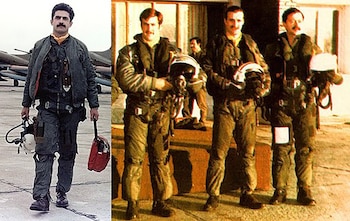

El capitán Pablo Carballo, el alférez Jorge Barrionuevo, el teniente Carlos Rinke y el 1er teniente Mariano Velasco del Grupo 5 de Caza en la base de Río Gallegos de la Fuerza Aérea durante la guerra de Malvinas.
Descendiente de un bisabuelo alemán de Hamburgo, Rinke había nacido en la ciudad de Buenos Aires el 17 de febrero de 1956 y desde chico vivió en San Isidro. Tan entusiasmado quedó que, cursando el tercer año del secundario, quiso entrar a la Escuela de Aviación Militar y lo rebotaron porque no cumplía con la edad. Ingresó dos años después, con la idea de transformarse en piloto de caza. Se había recibido de oficial en 1979.
Cuando estalló la guerra, estaba en la V Brigada Aérea y combatió a bordo de un Douglas A-4B Skyhawk del Grupo 5 de Caza. Entonces, “el flaco Rinke” era un teniente de 26 años, casado con una hija muy chica y estaban esperando otra, que nacería en agosto.

Carlos Rinke a A bordo de su herramienta de trabajo. En el ataque a Bahía Agradable, integró la primera oleada
Su bautismo de fuego fue el 1 de mayo y no lo recordaba como un gran día. Antes de llegar a la zona de blanco, la escuadrilla que integraba tuvo la mala suerte de cruzarse con un buque, que resultó ser el Formosa, al que atacaron. Participó en misiones los días 21, 23, 25 y 27 de mayo y 8 de junio.
El 23 de mayo, la escuadrilla Nene partió de la base de Río Gallegos para atacar blancos de ocasión. Ese día, que presentaba un cielo encapotado, el plan era que despegaran ocho pilotos ordenados en dos escuadrillas. Pero por problemas técnicos en algunas de las máquinas, se armó una sola conformada por el capitán Pablo Carballo, el primer teniente Luciano Guadagnini, el teniente Carlos Rinke y el alférez Hugo Gómez.
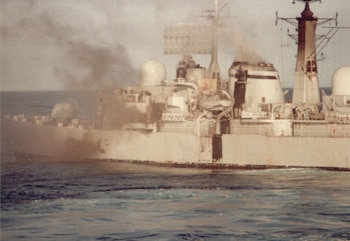

Hundimiento del Destructor Coventry, acción que Rinke evocaba particularmente
Volaban bajo, separados unos cincuenta metros cada uno. Enfilaron hacia el norte y cuando veían a la bahía de San Carlos a su derecha, se encontraron con varios buques enemigos. Los pilotos se repartieron los blancos: Carballo y Gómez se dirigieron al norte de la bahía y atacaron la fragata Antelope.
Guadagnini y Rinke enfilaron hacia la izquierda y la atacaron. Le arrojaron una bomba que no dio en el blanco.
Desde la Antelope, cuando distinguieron al avión de Guadagnini le abrieron fuego, y también desde tierra. Hicieron blanco en su ala derecha lo que provocó que su avión se inclinase de tal forma que pareció que se estrellaría en el agua. Sin embargo, el piloto logró enderezarlo y cuando trataba de salir impactó con el mástil de la nave y el avión, destrozado, cayó al mar. Seguidamente, dio en el blanco la bomba que había arrojado pero no explotó, alojándose en la cámara de suboficiales y matando a un camarero de 18 años.

Teniente Carlos Alfredo RINKE,Alferez Hugo GOMEZ,Alferez Ruben VOTTERO. Agachados: Capitan Pablo Marcos CARBALLO,Primer Teniente Carlos Eduardo CACHON
Rinke evocaba especialmente la misión del 25 de mayo, cuando hundieron el destructor Coventry, en la que ningún avión había sido derribado y se logró hundir un buque.
Fue, además, uno de los pilotos que atacaron a la flota inglesa el 8 de junio en Bahía Agradable, que pasó a la historia como el mayor desastre británico en la guerra de Malvinas.
Ese martes integró la primera oleada de ataque. Por desperfectos técnicos, se conformó una sola escuadrilla con el primer teniente Carlos Cachón, el alférez Leonardo Carmona, el propio Rinke, el teniente Daniel Gálvez y el alférez Hugo Gómez.


8 de junio: ataque de la aviación argentina en Bahía Agradable, donde los británicos planeaban desembarcar
El día presentaba muy baja visibilidad, con mucha neblina. Volaban al ras del agua. Para ese piloto de 26 años era algo “muy lindo y desafiante” y no sentía el temor de lo que pudiera pasar.
Integraba una de las promociones más jóvenes que estaban combatiendo: dos tenían 25 años, otros dos 26 y uno 28.
Tuvieron dificultad en identificar a los buques enemigos, camuflados en la costa. En una de las pasadas, fue Gómez el que los avistó. La escuadrilla realizó un amplio viraje hacia la derecha para atacar.
Después de Malvinas continuó su carrera. Su último destino fue en el Grupo 4 de Cazabombardeo en Mendoza, y había sido agregado aeronáutico adjunto en la embajada argentina en Estados Unidos entre 2001 y 2002.
En 2005, luego de más de treinta años de carrera, se había retirado como comodoro. Si bien durante toda su vida había sido piloto, pasaba su tiempo no en el aire sino bien pegado al agua, con un velero en el Lago San Roque.
Estaba casado con María Gabriela Fierro, fue padre de cinco hijos —María, Josefina, Tomás, Juan y Lucas—y tenía doce nietos.
No quiso volcarse a la escritura de lo que había vivido en Malvinas, aunque fue a numerosas a escuelas a dar charlas y se prestaba a muchas conferencias.
Apodado durante la guerra “Numeral de Hierro” por su arrojo en el combate y por la seguridad que le brindaba a sus camaradas, repetía que “salir con un compañero y volver sin él… eso no se olvida”.
Explicación:
Cuando decimos que el nombre del comodoro (R) VGM Carlos Alfredo Rinke es el de mayor trayectoria entre los pilotos de la Aviación Militar Argentina, involucramos a la Aviación de Ejército Argentino cuyo bautismo de fuego ocurrió en 1975 en Tucumán, provincia argentina, en el marco del Operativo Independencia contra-terrorista.
Por Adrián Pignatelli / Infobae
Versión en inglés
Carlos Rinke is the great hero in the history of Argentine Military Aviation. He logged the highest number of combat sorties and flight hours. (Article translated into English)
His baptism by fire coincided with that of the Argentine Air Force. He is remembered for his participation in high-risk missions during the South Atlantic War. He flew six such missions, returning unscathed each time; on one occasion, he even saved his flight leader, Commodore (Ret.) Pablo Carballo—a veteran of the conflict. As an A-4B pilot, he took part in the attacks on the ships *Broadsword* and *Coventry*, as well as the operation at Bluff Cove (Bahía Agradable). He passed away in Córdoba at the age of 70.
[Photograph: Carlos Rinke in his fighter pilot uniform. During the Malvinas War, he took part in half a dozen combat operations.]
That enthusiastic teenager who eagerly awaited Air and Space Week, an event that brought together aircraft of all types and models in one place; the boy who built airplane scale models and dreamed big when mankind reached the Moon; and the young man who became completely fascinated when he first saw the newly acquired A-4B Skyhawks, has now completed his final mission.
Retired Commodore Carlos Alfredo Rinke—a Falklands War veteran known as the “Iron Wingman” and an A-4B Skyhawk pilot with the 5th Fighter Group—passed away at the age of 70. In 1982, he had flown six combat sorties against the British fleet, returning safely from each one. He underwent a bone marrow transplant—with his youngest son, Lucas, serving as the donor—on October 19, 2026, but ultimately did not survive the leukemia.
[Photograph: Captain Pablo Carballo, Ensign Jorge Barrionuevo, Lieutenant Carlos Rinke, and First Lieutenant Mariano Velasco of the 5th Fighter Group at the Río Gallegos Air Force Base during the Malvinas War.]
A descendant of a German great-grandfather from Hamburg, Rinke was born in Buenos Aires on February 17, 1956, and spent his childhood in San Isidro. So determined was he to become a pilot that, during his third year of secondary school, he tried to enroll in the Military Aviation School but was rejected because he was too young. Two years later he was accepted, with the goal of becoming a fighter pilot. He graduated as an officer in 1979.
He completed four years as a cadet, during which aircraft were mostly seen from a distance. In 1978 he became an officer, and the following year he completed fighter pilot training in Mendoza flying the Morane-Saulnier aircraft.
When the war began, he was assigned to the V Air Brigade and flew combat missions in a Douglas A-4B Skyhawk with the 5th Fighter Group. At the time, the “skinny Rinke” was a 26-year-old lieutenant, married, with a young daughter and another child on the way, who would be born in August.
[Photograph: Carlos Rinke beside his aircraft. During the attack on Bluff Cove, he flew in the first assault wave.]
His first combat mission took place on May 1, 1982, a day he did not remember fondly. Before reaching their intended target area, his squadron unexpectedly encountered a vessel later identified as the Formosa, which they attacked. He would later fly missions on May 21, 23, 25, and 27, and on June 8.
A devout Catholic, he had the habit of praying the Rosary before departing on combat missions.
The Attack on Broadsword
On May 23, the “Nene” flight departed from Río Gallegos Air Base to seek targets of opportunity. The plan called for eight pilots in two flights, but technical problems reduced the force to a single formation consisting of Captain Pablo Carballo, First Lieutenant Luciano Guadagnini, Lieutenant Carlos Rinke, and Ensign Hugo Gómez.
[Photograph: Sinking of the destroyer HMS Coventry, a mission Rinke remembered with particular pride.]
Flying low and approximately fifty meters apart, they headed north. As they saw San Carlos Bay to their right, they encountered several enemy ships.
Carballo and Gómez attacked the frigate HMS Antelope. Meanwhile, Guadagnini and Rinke turned toward HMS Broadsword and launched their attack. Their bomb missed the target.
As Guadagnini’s aircraft approached, both naval and ground defenses opened fire. His right wing was struck, causing the aircraft to roll sharply as if it would crash into the sea. He managed to regain control, but moments later his aircraft struck the ship’s mast. The badly damaged aircraft crashed into the ocean.
The bomb he had released hit the target but failed to explode, becoming lodged in the petty officers’ quarters. It nevertheless caused the death of an 18-year-old steward.
[Photograph: Lieutenant Carlos Alfredo Rinke, Ensign Hugo Gómez, and Ensign Rubén Vottero. Kneeling: Captain Pablo Marcos Carballo and First Lieutenant Carlos Eduardo Cachón.]
The Sinking of HMS Coventry
Rinke often highlighted the mission of May 25, when Argentine aircraft sank the destroyer HMS Coventry. He regarded it as a particularly significant success because no Argentine aircraft were lost and the attacking force succeeded in sinking an enemy warship.
Bluff Cove: The Largest British Disaster of the War
Rinke was also among the pilots who attacked British forces at Bluff Cove (Bahía Agradable) on June 8, an operation widely regarded as the greatest British disaster during the Malvinas War.
That Tuesday he flew as part of the first attack wave. Due to technical problems, only one flight was formed, led by First Lieutenant Carlos Cachón and including Ensign Leonardo Carmona, Lieutenant Carlos Rinke, Lieutenant Daniel Gálvez, and Ensign Hugo Gómez.
Rinke later described Cachón as an exceptionally disciplined pilot. Together with First Lieutenant Mariano Velasco, who had scored hits against Coventry on May 25, Cachón was known for his outstanding bombing accuracy.
[Photograph: June 8 attack by Argentine aviation at Bluff Cove, where British forces were preparing an amphibious landing.]
The weather featured extremely poor visibility and dense fog. Flying just above the water, Rinke considered the mission “very enjoyable and challenging” and did not dwell on the dangers involved.
Their group belonged to one of the youngest combat cohorts in the war: two pilots were 25 years old, two were 26, and one was 28.
The pilots initially struggled to identify enemy ships because they were concealed along the shoreline. Gómez eventually spotted them, and the formation carried out a wide right turn to begin the attack.
The pilots were surprised to receive almost no enemy fire. They attacked the landing ships Sir Galahad and Sir Tristram. Bombs dropped by Cachón struck their targets, while Rinke’s bombs skipped off the water and exploded on the coast. The formation then returned to base without rearming.
A second attack wave followed later, producing some of the war’s most dramatic moments for Argentine pilots.
Life After the War
Following the Malvinas conflict, Rinke continued his Air Force career. His final posting was with the 4th Fighter-Bomber Group in Mendoza. Between 2001 and 2002, he served as Deputy Air Attaché at the Argentine Embassy in the United States.
In 2005, after more than thirty years of service, he retired with the rank of Commodore. Although aviation had defined his life, he preferred spending his free time near the water, sailing on Lake San Roque.
He was married to María Gabriela Fierro and was the father of five children: María, Josefina, Tomás, Juan, and Lucas. He also had twelve grandchildren.
He never sought to write a memoir about his wartime experiences, although he frequently visited schools and participated in conferences to share his memories and lessons learned.
Known during the war as the “Iron Wingman” because of his courage in combat and the confidence he inspired in fellow pilots, he often repeated a phrase that captured the lasting emotional impact of war:
“Going out on a mission with a companion and coming back without him… that is something you never forget.”
Explanation:
When we state that Commodore (Ret.) Carlos Alfredo Rinke—a veteran of the Malvinas War (VGM)—possesses the most extensive service record among pilots in the Argentine military aviation branches, this also encompasses the Argentine Army Aviation, whose baptism by fire took place in 1975 in the Argentine province of Tucumán, as part of the counter-terrorist «Operation Independence.»
The baptism by fire for the Argentine Naval Aviation occurred on May 4, 1982, during the Malvinas War. On that day, two Super Étendard aircraft from the 2nd Naval Fighter and Attack Squadron—having been refueled in mid-air by an Argentine Air Force KC-130 tanker—took off and launched Exocet AM 39 anti-ship missiles at the British destroyer HMS Sheffield, inflicting fatal damage. This operation marked the first successful naval aviation strike by the Argentine Navy in an actual armed conflict.}
But Rinke surpasses all the events that took place during air operations.
Source Adrián Pignatelli / Infobae: obituary article on Carlos Alfredo Rinke, Argentine Air Force veteran and Malvinas War combat pilot. Matilde Fierro / Primicias Rurales
Traducción al inglés: María Marta Cafiero